Picture a glass of water that looks perfectly clear. Now imagine that the water is actually full of particles so small that a microscope you’d find in a school lab still cannot see them properly. These particles are nanoparticles, and scientists need a way to know exactly how big they are, because their size decides whether a medicine works, whether a sunscreen stays smooth, or whether a vaccine reaches the right cells in the body.
This is where Dynamic Light Scattering, usually just called DLS, comes in. It is one of the most common tools used around the world to measure the size of these tiny particles. This guide explains DLS from the very beginning, in plain words, so that even someone who has never touched a lab instrument can follow along. By the end, you will also understand the more advanced parts, like zeta potential, applications, advantages, and why this small machine matters so much in nanotechnology.
What Exactly Is a Nanoparticle?
A nanometer is a unit of length. One nanometer is so small that if you lined up a million of them side by side, you would only get one millimeter, which is about the thickness of a fingernail. A nanoparticle is simply a particle whose size falls somewhere between 1 nanometer and 1000 nanometers (which equals 1 micron).
To put this in everyday terms, a human hair is about 80,000 to 100,000 nanometers wide. A nanoparticle is often hundreds or even thousands of times smaller than that hair. You cannot see these particles with your eyes, and even a normal light microscope struggles to see most of them clearly. That is exactly why a special technique like DLS exists.
What Does “Dynamic Light Scattering” Actually Mean?
The name itself tells you almost the whole story once you break it into three simple words.
Light refers to a laser beam, which is just a very focused, single-colored beam of light used in the instrument.
Scattering is what happens when that light beam hits something small, like a particle, and bounces off in different directions instead of going straight through. You can see something similar when sunlight passes through a dusty room. The light beam becomes visible because it scatters off tiny dust particles floating in the air.
Dynamic means the scattering pattern keeps changing over time because the particles in the liquid are never sitting still. They are constantly moving in a random, jittery way.
So, put together, Dynamic Light Scattering means: studying how the pattern of bouncing light keeps changing because the particles causing that bounce are constantly, randomly moving. That random movement is the real key to the entire technique, and it has a name of its own, which we will explain next.
The Principle of DLS Measurement: How It Actually Works, Step by Step
This is the heart of the whole technique. Once you understand this part, everything else about DLS becomes much easier to follow.
Step 1: Every Particle in a Liquid Is Constantly Wiggling
Imagine dropping a small ball into a pool full of millions of tinier, invisible balls that are all moving because of heat energy. Every time one of those invisible balls bumps your ball, it pushes it slightly in a random direction. Because this happens from every side at once, your ball jitters around in a random zig-zag path instead of moving in a straight line.
This is what happens to nanoparticles in a liquid. Water molecules are always moving because of heat, and they constantly collide with the nanoparticles from every direction. This random jittering is called Brownian motion, named after the scientist who first studied it closely, and later explained mathematically by Albert Einstein in 1905.
Here is the important part: small particles jitter faster than big particles. Think of a ping-pong ball versus a bowling ball, both being pushed around in the same pool. The light ball gets knocked around quickly; the heavy one barely moves with the same pushes. Nanoparticles work the same way – small ones move fast, big ones move slowly.
Step 2: A Laser Beam Watches This Movement
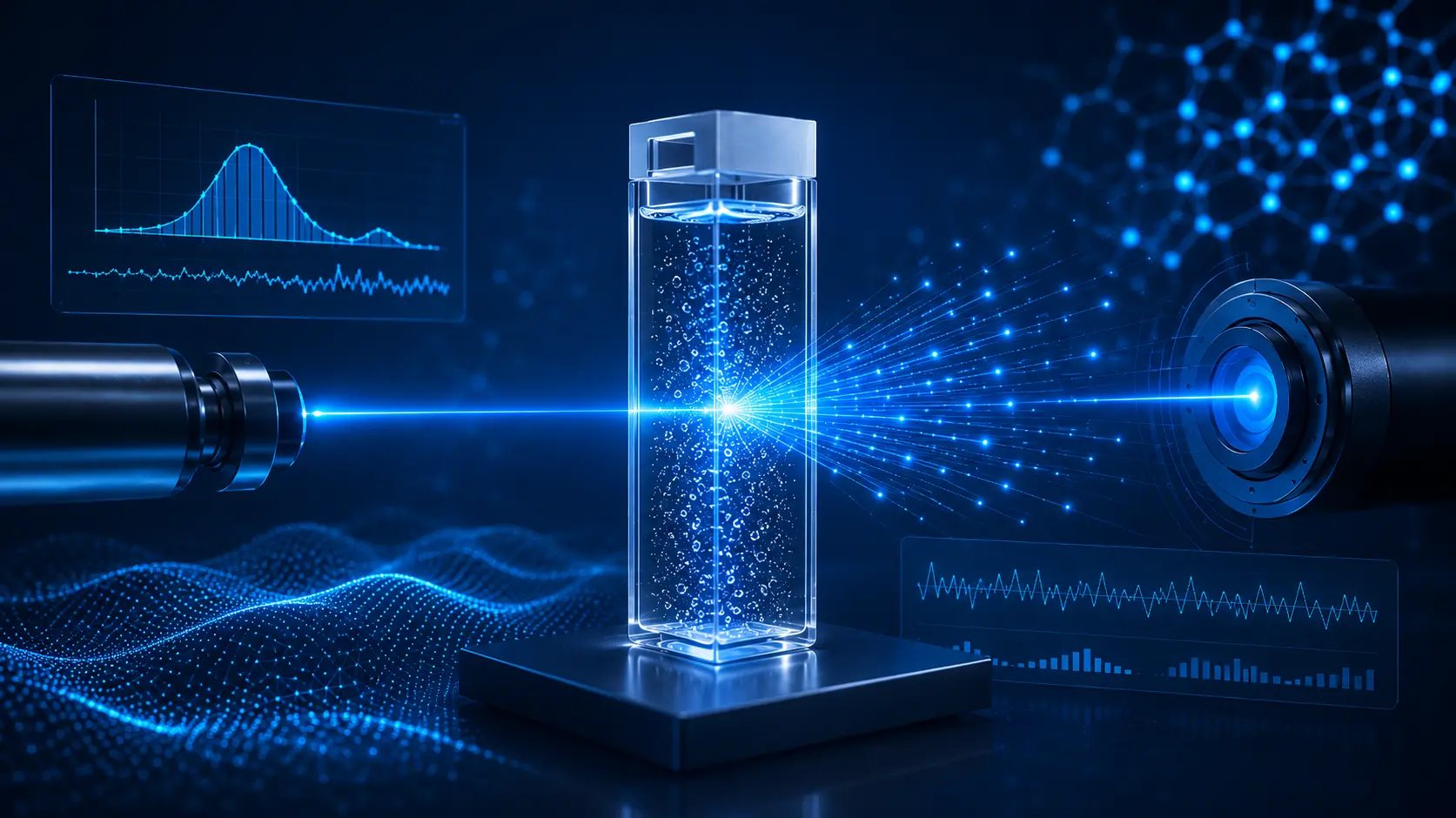
A DLS machine shines a laser beam through the liquid sample, held in a small clear container called a cuvette. When the laser hits a nanoparticle, some light bounces off and scatters in different directions, the same way light scatters off dust floating in a sunbeam.
A detector watches this scattered light from a fixed angle, often 173 degrees in modern machines (called backscatter detection), or 90 degrees in older designs. The exact angle is a technical detail; the idea stays simple – the detector constantly watches how much scattered light arrives, moment by moment.
Step 3: The Scattered Light Flickers, and That Flicker Tells the Real Story
Since the particles keep jittering, the scattered light reaching the detector keeps flickering too – brighter one instant, dimmer the next, all within milliseconds.
Small particles jitter quickly, so the light flickers quickly. Large particles jitter slowly, so the light flickers more slowly and smoothly. The DLS machine is essentially “listening” to the speed of this flicker to work out particle size, much like guessing whether a crowd is made of sprinters or slow walkers just by watching how fast their positions shuffle around.
Step 4: A Computer Calculation Called the Autocorrelation Function
To turn this flicker into an actual number, the software runs a comparison called an autocorrelation function. In plain words, it takes the flickering signal and compares it to itself a moment later, then a bit later again, and so on.
If particles are small and fast, the signal becomes different from its earlier self very quickly. If particles are large and slow, the signal still looks similar to its earlier self even after a longer delay. By measuring how fast this “similarity” fades, the software calculates a diffusion coefficient, a number describing how fast the particles move through the liquid.
Step 5: Turning the Diffusion Speed Into an Actual Size
The diffusion coefficient alone is just a speed number, not yet a size. To convert it, the software uses the Stokes-Einstein equation, which connects diffusion speed, the liquid’s thickness (viscosity), and temperature.
This calculation gives the hydrodynamic diameter, the size of an imaginary, perfectly round sphere that would diffuse at the same speed as the real particle, including any thin coating or liquid layer stuck to its surface. This is why DLS size often comes out a little larger than the “dry” size seen under an electron microscope.
Step 6: The Final Result – Z-Average Size and PDI
Once all this math is finished, the DLS machine gives you two main numbers.
The first is called the Z-average size. This is essentially the average size of all the particles in the sample, weighted heavily toward larger particles, since bigger particles scatter much more light than smaller ones.
The second is called the Polydispersity Index, or PDI. This number, which ranges from 0 to 1, tells you how spread out the particle sizes are in your sample. A PDI close to 0 means almost all particles are roughly the same size (this is called a monodisperse sample). A higher PDI, especially above 0.3, often suggests that the sample contains particles of many different sizes or that some particles have clumped together, a process called aggregation.
| Term | Simple Meaning | What It Tells You |
| Z-average | Average particle size, weighted toward bigger particles | Main size number reported by DLS |
| PDI | A score from 0 to 1 showing how mixed the sizes are | Below 0.1 means very uniform; above 0.3 often signals trouble |
| Measurement range | Roughly 0.3 nanometers to 10 microns | Sets the smallest and largest particles DLS can usually detect |
Zeta Potential in DLS Systems, Explained Simply
Now that you understand how DLS measures size, the next big idea is zeta potential, which many DLS machines can also measure using a slightly different setup.
What Is Zeta Potential?
Almost every nanoparticle floating in a liquid carries a tiny electrical charge on its surface, similar to how a balloon picks up a static charge after rubbing it on your hair. This charge pulls in a thin layer of oppositely charged ions from the liquid, sticking loosely around the particle like an invisible cloud. Scientists call this cloud the electrical double layer.
Zeta potential is the strength of the charge measured right at the outer edge of this cloud, called the slipping plane, compared to the open liquid far away. It is measured in millivolts (mV) and works as a stand-in number for how strongly charged a particle’s surface really is.
Why Does Zeta Potential Matter So Much?
Charged particles that carry the same type of charge push each other away, the same way two magnets with matching poles repel. If nanoparticles in a liquid carry a strong charge of the same sign, they keep pushing apart and stay spread out and stable. If the charge is weak, nothing stops them from drifting together, sticking, and forming bigger clumps, a process called aggregation, which can ruin a medicine or cream that depends on tiny, evenly spread particles.
How a DLS Machine Actually Measures Zeta Potential
To measure zeta potential, the instrument uses a method called electrophoretic light scattering, or ELS. It applies an electric field across the sample, similar to placing a small battery on either side of it. Charged particles move toward whichever side carries the opposite charge, and this movement is called electrophoretic mobility.
The instrument detects this movement through a tiny shift in the scattered laser light’s frequency, called the Doppler shift – the same effect that makes an ambulance siren sound higher as it drives toward you and lower as it drives away. The machine measures this shift and converts it into a zeta potential value using methods set out in the ISO 13099 standard.
Reading Zeta Potential Numbers in Simple Terms
| Zeta Potential Range | What It Usually Means |
|---|---|
| Above +30 mV or below −30 mV | Strong charge, particles push each other apart, and the sample is usually stable |
| Between −30 mV and +30 mV | Weaker charge, particles may slowly drift together over time |
| Very close to 0 mV | Almost no charge at all, clumping risk is high |
This +30/−30 mV rule is a helpful general guideline, not a strict law. Some particles stay stable using a different trick entirely, called steric stabilization, where a thick physical coating (like a polymer layer) keeps particles apart through sheer bulk, even when the electrical charge is weak.
What Can Change a Zeta Potential Reading
A few everyday factors shift zeta potential readings. The pH of the liquid strongly affects how many charged ions attach to a particle’s surface. Adding salt increases ionic strength, which compresses the electrical double layer and can pull the reading toward zero, even if the particle itself has not changed. Temperature and the dispersing liquid also play a role, which is why every zeta potential result is reported together with its testing conditions.
Applications of DLS Analysis Across Different Industries
DLS earned its place in laboratories worldwide because so many industries depend on knowing two simple things: how big are these particles, and will they stay stable?
Medicines and Drug Delivery
This is probably the biggest use of DLS today. Many modern medicines, including certain vaccines, use tiny fat-based bubbles called lipid nanoparticles, or LNPs, to carry their active ingredients safely into cells. LNPs usually need to stay between 80 and 120 nanometers, a size that helps cells absorb them while avoiding early detection by the immune system. DLS confirms that every batch falls within this window before it reaches a patient.
Protein and Biology Research
Proteins used in biologic medicines can sometimes stick together over time, a problem called protein aggregation that can make a drug less safe or effective. Scientists run DLS during storage studies, watching for any sudden jump in size or PDI as an early warning sign of clumping.
Skincare and Cosmetics
Lotions, creams, serums, and sunscreens are usually built from tiny oil droplets or nanoparticles mixed into water. DLS checks droplet size and zeta potential during development, helping companies predict whether a product will stay smooth on a shelf or separate before its expiry date.
Food and Drinks
Some foods use nanoemulsions to carry flavors, vitamins, or natural preservatives evenly through a liquid. DLS confirms these droplets stay small and uniform, which affects taste, appearance, and shelf life.
Environmental Science
Researchers studying how engineered nanoparticles behave in rivers, soil, or living organisms use DLS to track size changes over time, since size strongly affects how far particles travel and how easily they enter cells.
Materials Science and Electronics
Gold particles, silica particles, quantum dots, and other engineered nanomaterials used in electronics and diagnostic kits are tested with DLS during manufacturing to confirm each batch matches the last.
Advantages of the DLS Technique, Explained Simply
-
Fast and Efficient Analysis
Dynamic Light Scattering (DLS) is a quick analytical technique. A complete measurement, including particle size and size distribution, typically takes between 30 seconds and a few minutes, making it ideal for high-throughput laboratory workflows.
-
Requires Only a Small Sample
DLS needs a very small amount of sample for analysis. Most instruments require only 3 to 50 microliters, which is smaller than a single drop of water. This makes the method especially useful when working with rare, valuable, or expensive biological materials.
-
Non-Destructive Testing
One of the major advantages of DLS is that it does not damage or consume the sample during analysis. After testing, the same sample can be measured again or used for additional experiments, helping conserve valuable materials.
-
Wide Particle Size Detection Range
A single DLS measurement can detect particles ranging from approximately 0.3 nanometers to several microns. This broad measurement range makes it suitable for analyzing proteins, viruses, polymers, liposomes, and a wide variety of engineered nanoparticles.
-
No Calibration Curve Required
Unlike many conventional analytical methods, DLS does not require a calibration curve before testing. This reduces preparation time and simplifies the overall measurement process while maintaining reliable results.
-
Measures Particles in Their Natural State
DLS analyzes particles while they remain suspended in liquid, allowing researchers to observe their natural behavior in solution. Because the sample is not dried or chemically altered, the results provide a more accurate representation of real-world conditions.
Limitations of DLS You Should Also Know
No tool is perfect, and understanding where DLS struggles helps prevent confusing or misleading results.
- Big particles can hide small ones:- The light a particle scatters increases sharply with size, following what scientists call the “sixth power rule.” A small number of large particles or clumps can dominate the signal and hide much smaller particles in the same sample.
- Mixed samples are hard to read clearly:- If a sample contains three or more very different particle sizes, DLS often struggles to separate them and may report one confusing average that matches none of the actual groups present.
- Dust ruins results quickly:- Stray dust scatters light strongly since it is usually much bigger than the nanoparticles being studied. Even a small amount can push the reported size higher than reality, which is why samples are almost always filtered before testing.
- It only gives averages, not individual counts:- DLS cannot tell you whether you are looking at one slightly bigger particle or two smaller particles stuck together. Other techniques, covered below, are sometimes needed for that level of detail.
Why DLS Matters So Much in Nanotechnology
Nanotechnology is entirely about controlling things at a scale invisible to the eye, often a thousand times smaller than a human hair. Without a fast, easy-to-use way to check whether particles are the right size and stable enough to use, nanomedicine, nanoelectronics, and nanomaterials research would move more slowly and carry more risk.
Health regulators, including the FDA and the EMA, expect detailed particle size and PDI data as part of any nanoparticle-based drug application, and DLS remains the standard method used to produce it.
Research labs run DLS almost daily to confirm a new batch matches earlier ones, a check known as batch-to-batch consistency, which is the backbone of trustworthy science.
In manufacturing, DLS works almost like an early alarm system. A size or zeta potential reading drifting outside its expected range can flag a hidden problem before it grows into something bigger and costlier.
DLS Compared to Other Particle Sizing Methods
DLS is popular, but it is not the only sizing tool available. Knowing how it compares to others helps explain when scientists choose it, and when they reach for something else instead.
| Method | What It Actually Measures | Main Strength | Main Limitation |
| DLS | Hydrodynamic size, as an overall average | Fast, needs very little sample, wide size range | Large particles can hide smaller ones in the result |
| Nanoparticle Tracking Analysis (NTA) | Tracks individual particles one by one under a camera | Can separate mixed particle populations clearly, counts particles directly | Needs a more diluted sample, runs slower than DLS |
| Electron Microscopy (SEM/TEM) | The actual physical size and shape of dried particles | Extremely detailed, true shape and size | Sample preparation can change the particles; not measured in liquid |
| Laser Diffraction | Size distribution based on particle volume | Works very well for larger particles | Less accurate for particles smaller than 100 nanometers |
Most research labs do not depend on just one of these methods alone. DLS is very often paired with electron microscopy or NTA, since each method answers a slightly different piece of the same overall question.
Simple Tips for Getting Accurate DLS Results
1. Filter your sample first
Passing the liquid through a fine filter (commonly 0.2 or 0.45 microns) removes stray dust, unless the particles you want to measure are close to that size themselves.
2. Use the correct liquid settings
Match the viscosity and refractive index settings in the software to the real liquid used; wrong values throw off the calculated size.
3. Keep the concentration balanced
Too dilute gives a weak signal; too concentrated causes light to scatter multiple times before reaching the detector, distorting results.
4. Let the sample reach a stable temperature
Both liquid thickness and particle movement depend on temperature, so let the sample settle before measuring.
5. Always check the PDI alongside the size
A size number alone can mislead. The PDI gives a clearer picture of how uniform or mixed the sample really is.
Final Thoughts
Dynamic Light Scattering takes something completely invisible to the human eye – the constant random jittering of tiny particles inside a liquid – and turns it into a clear, trustworthy number. Add zeta potential into the picture, and a single quick test can tell scientists both how big their nanoparticles are and how likely those particles are to stay stable over time, instead of clumping together.
Instrument makers like Apex Instruments have made this kind of precise, everyday measurement accessible to labs across pharmaceuticals, cosmetics, and materials science, helping teams catch problems long before they reach a shelf or a patient. From life-saving vaccines to everyday sunscreen, this simple but clever idea, built entirely on watching how light flickers, quietly supports an enormous amount of modern science and technology working behind the scenes.
FAQs
What does DLS stand for in nanoparticle analysis?
DLS stands for Dynamic Light Scattering, a method that measures how big particles are in a liquid by watching how laser light bounces off them as they move randomly.
What is the simplest way to understand how DLS works?
DLS shines a laser through a sample and watches how fast the scattered light flickers. Fast flickering means small particles; slow flickering means larger ones.
What is the main difference between particle size and zeta potential?
Particle size tells you how big the particles are. Zeta potential tells you how strongly charged their surface is, which affects whether they stay spread apart or clump together.
What size range can DLS actually measure?
Most DLS machines measure particles from around 0.3 nanometers up to about 10 microns, though this depends on sample concentration and instrument sensitivity.
What counts as a good PDI value in DLS?
A PDI below 0.1 usually means very uniform particles. In pharmaceutical testing, below 0.3 is commonly considered acceptable, while higher values often point to mixed sizes or clumping.
What does Z-average size mean?
Z-average is the main size value reported by DLS – an average that leans more heavily toward larger particles, since they scatter much more light than smaller ones.
Is DLS the only way to measure nanoparticle size?
No. Other tools such as Nanoparticle Tracking Analysis, electron microscopy, and laser diffraction are also used, depending on what exactly needs to be measured.
How is DLS different from Nanoparticle Tracking Analysis (NTA)?
DLS measures an overall average across all particles at once, while NTA tracks each particle individually under a camera, which usually separates mixed sizes better but runs slower.
Why is zeta potential measured in millivolts?
Zeta potential is a type of electrical voltage difference, and millivolts is the natural unit used to measure such small voltage differences.
What does a negative zeta potential value mean?
It means the particle’s surface carries a net negative charge. The sign alone does not signal instability; what matters is how far the number sits from zero, with values beyond ±30 mV usually considered stable.
How long does a typical DLS test take?
A standard measurement usually takes between 30 seconds and a few minutes, depending on the sample and the number of repeat runs requested.
Can DLS detect if proteins are clumping together?
Yes. A rising particle size or PDI value over time during storage testing is a common early sign of protein aggregation.
How much liquid sample does DLS actually need?
Many modern machines need only 3 to 50 microliters, roughly the size of a small water droplet, which helps when samples are rare or costly.
Does DLS work well on samples with many different particle sizes mixed together?
Not very well. Bigger particles scatter far more light than smaller ones and can hide them completely in the result.
What exactly is hydrodynamic diameter?
It is the size of an imaginary sphere that would move through a liquid at the same speed as the real particle, including any coating or liquid layer attached to it.
Which official standards cover DLS testing?
ISO 22412 covers how DLS should measure particle size, while zeta potential measurement by optical methods falls under ISO 13099-2.
Is DLS used in real pharmaceutical manufacturing, or only in research labs?
Both. DLS is a routine quality control and release test for nanoparticle drug products, and its data is commonly included in regulatory submissions.
Does room temperature affect DLS test results?
Yes. Temperature affects both liquid thickness and how fast particles naturally jiggle, so samples are usually allowed to settle at one steady temperature before testing.
Contact:
Contact us to improve refinery testing with advanced ICP-MS solutions and get a quote today.
Mobile/WhatsApp: +971526191767
Email: sales@apex-instrument.com