In mining and mineral processing, knowing exactly what is present in an ore sample is essential for making the right decisions. The concentration of metals can influence whether an ore deposit is economically viable, how it should be processed, and how efficiently valuable elements can be recovered.
This is where Atomic Absorption Spectroscopy (AAS) plays an important role. AAS is an established analytical technique used to determine the concentration of specific metallic elements in prepared samples. It is particularly useful for the analysis of geological materials, ores, concentrates, soils, and other mining-related samples.
AAS can be used to quantify elements such as copper, zinc, lead, iron, nickel, manganese, cobalt, chromium, cadmium, and several other metals, depending on the instrument configuration and analytical method. The U.S. Environmental Protection Agency includes both flame and graphite furnace atomic absorption methods within its established analytical methods for metals.
For mining laboratories, the value of AAS is not simply in detecting metals. It is in producing quantitative elemental data that can support exploration, ore grading, process control, quality assurance, and environmental monitoring.
What Is Atomic Absorption Spectroscopy?
Atomic Absorption Spectroscopy is an analytical technique based on the ability of free atoms to absorb light at characteristic wavelengths.
In simple terms, every element absorbs specific wavelengths of light. During AAS analysis, the sample is converted into free atoms, and light at a wavelength characteristic of the element being measured is passed through those atoms.
The atoms absorb part of the light. The instrument measures this absorption and relates it to the concentration of the element in the sample.
A typical AAS system includes:
- A light source, commonly a hollow cathode lamp specific to the element being measured
- An atomization system, such as a flame or graphite furnace
- A monochromator to isolate the required wavelength
- A detector to measure absorbed radiation
- Software for calibration, measurement, and data processing
The basic principle is supported by EPA descriptions of atomic absorption, which explain that metal atoms in a flame or furnace absorb characteristic radiation and that the measured absorption is related to the concentration of the metal.
Why Is AAS Important in Mining?
Mining operations deal with complex materials. An ore sample may contain the target metal along with large amounts of other minerals and elements.
For example, a copper ore may contain copper-bearing minerals together with iron, sulfur, silica, calcium, aluminum, and other components. Knowing the concentration of copper alone can therefore be critical for evaluating the material.
AAS provides a practical way to measure selected elements quantitatively after appropriate sample preparation.
Its applications can include:
- Ore grade determination
- Mineral exploration
- Geochemical analysis
- Concentrate testing
- Process control
- Metallurgical studies
- Quality control
- Environmental monitoring around mining operations
The USGS has documented AAS methods for determining copper, zinc, and lead in geological materials, demonstrating the technique’s application to a range of geological sample matrices.
How Does AAS Analyze Ore and Mineral Samples?
AAS does not normally analyze a solid rock or ore sample simply by placing it directly into the instrument. Sample preparation is an important part of the analytical process.
A simplified workflow is as follows.
1. Sampling
The first step is obtaining a representative sample.
Mining materials can be highly heterogeneous, so the laboratory sample must represent the material being investigated. Poor sampling can affect the final result regardless of how advanced the analytical instrument is.
2. Crushing and Grinding
Ore samples are generally crushed and ground to achieve a suitable and sufficiently homogeneous particle size.
This helps improve sample representativeness and allows the target elements to be more effectively brought into solution during digestion.
3. Chemical Digestion
The prepared sample is treated with suitable acids or other reagents to dissolve the elements of interest.
The exact digestion procedure depends on the sample matrix and the elements being measured. Geological samples can be chemically complex, so selecting an appropriate digestion method is important.
USGS work on geological materials, for example, has used acid digestion before AAS determination of copper, zinc, and lead.
EPA guidance also notes that solid samples generally require digestion or solubilization before graphite furnace AAS analysis because the technique is primarily applied to metals in solution.
4. Atomization
Once the sample has been converted into a suitable solution, it is introduced into the AAS.
Depending on the concentration and analytical requirement, the instrument may use flame atomization or graphite furnace atomization.
5. Measurement
The atoms absorb their characteristic wavelength of light. The amount of absorption is measured and compared with calibration standards.
The resulting measurement is converted into the concentration of the target element in the prepared sample.
Flame AAS vs. Graphite Furnace AAS
Two commonly used forms of atomic absorption are Flame Atomic Absorption Spectroscopy (FAAS) and Graphite Furnace Atomic Absorption Spectroscopy (GFAAS).
Flame Atomic Absorption Spectroscopy
In FAAS, the sample solution is introduced into a flame, where it is converted into free atoms.
FAAS is widely used when the concentration of the target element is sufficiently high for flame detection. It is generally faster and straightforward for routine analysis.
EPA describes flame AAS as an established method for determining numerous metals, including aluminum, barium, cadmium, calcium, chromium, cobalt, copper, iron, lead, magnesium, manganese, nickel, silver, sodium, vanadium, and zinc.
For mining laboratories, this can make FAAS useful for routine determination of metals present at moderate concentrations.
Graphite Furnace AAS
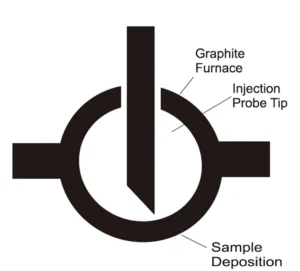
GFAAS uses a graphite furnace instead of a flame. A small quantity of sample is introduced into the furnace and subjected to controlled heating steps before atomization.
Because the sample is concentrated within a small furnace volume, graphite furnace AAS can provide higher sensitivity for many trace-element applications.
EPA’s Method 7010 identifies graphite furnace AAS for metals including arsenic, cadmium, chromium, cobalt, copper, iron, lead, manganese, molybdenum, nickel, selenium, silver, thallium, vanadium, and zinc.
The choice between flame and furnace depends on the element, concentration range, sample matrix, required detection capability, and analytical method.
Key Mining Applications of AAS
1. Ore Grade Analysis
One of the most important applications of elemental analysis in mining is determining the concentration of valuable metals in ore.
For example, copper, zinc, lead, nickel, or iron concentrations can help laboratories characterize ore samples and support decisions related to mining and processing.
Accurate grade information is particularly important because even relatively small differences in metal concentration can affect the economic evaluation and processing strategy for an ore body.
2. Mineral Exploration
During mineral exploration, laboratories may analyze large numbers of geological samples to identify areas with elevated concentrations of target elements.
AAS can be used for quantitative analysis of selected metals after appropriate sample preparation.
Historical geological work has demonstrated the use of AAS for copper, lead, and zinc determination in geochemical samples, where analytical sensitivity and processing speed are important when dealing with numerous samples.
3. Concentrate Analysis
After ore has been processed, mineral concentrates may be tested to determine their elemental composition.
AAS can help measure target metals and provide data for quality control and process evaluation.
This information can help laboratories determine whether a concentration or separation process is producing material within the expected specifications.
4. Process Control
Mining and mineral processing are not static operations. Changes in feed composition can affect recovery and process performance.
Regular elemental analysis can provide laboratory data that helps metallurgists understand changes in feed material and evaluate the performance of processing stages.
AAS can therefore form part of a broader laboratory testing workflow used alongside other analytical techniques.
5. Environmental Monitoring
Mining activities can also involve monitoring metals in surrounding soil, water, sediments, and other environmental samples.
Elements such as lead, cadmium, arsenic, chromium, and other metals may require monitoring depending on the site and applicable regulations.
AAS methods are established for metal analysis in environmental matrices. EPA’s analytical methods include flame and graphite furnace AAS for various metals in environmental samples.
What Makes AAS Useful for Mining Laboratories?
Element-Specific Analysis
AAS is designed for measuring specific elements using their characteristic absorption wavelengths. This makes it suitable when a laboratory needs quantitative information for selected metals.
Good Sensitivity
Depending on the element, instrument configuration, and analytical method, AAS can measure metals across a useful range of concentrations. Graphite furnace systems can provide higher sensitivity than flame systems for many trace-level applications.
Suitable for Routine Laboratory Testing
AAS has been used for decades in analytical laboratories and has established methodologies for many elements. This makes it a practical choice for laboratories that routinely analyze mining and geological samples.
Quantitative Results
Unlike a simple qualitative screening technique, AAS is used to determine the concentration of the target element. Calibration against appropriate standards is an important part of obtaining quantitative results.
Flexible Application
Different atomization techniques and sample preparation procedures allow AAS to be adapted to different analytical requirements.
Factors That Affect the Accuracy of AAS Results
Having an AAS instrument does not automatically guarantee accurate analytical results. The complete testing process matters.
Representative Sampling
If the laboratory sample does not accurately represent the ore or geological material, the analytical result may not represent the larger material either.
Sample Preparation
Crushing, grinding, weighing, digestion, dilution, and filtration can all affect the final result. Incomplete digestion, contamination, or incorrect dilution can introduce significant errors.
Matrix Effects
Mining samples can contain high concentrations of other elements that may interfere with the analysis.
Analysts therefore need to consider chemical and physical interferences and select suitable analytical conditions.
EPA guidance specifically highlights the importance of understanding chemical and physical interferences when performing graphite furnace AAS.
Calibration
Accurate standards and appropriate calibration procedures are essential for converting measured absorbance into reliable concentration values.
Quality-control samples, blanks, calibration checks, and appropriate reference materials can further strengthen confidence in the results.
AAS vs. Other Elemental Analysis Techniques
AAS is not the only analytical technology used in mining laboratories.
Techniques such as XRF, ICP-OES, and ICP-MS also have important roles in mineral and metals analysis.
The best technique depends on the application.
AAS can be particularly useful when a laboratory needs quantitative analysis of selected elements and has established methods for those analytes.
XRF is widely used for rapid elemental screening and analysis of solid geological and mineral samples, often with limited sample preparation depending on the application.
ICP-OES can measure multiple elements in a sample and is useful when multi-element analysis is required.
ICP-MS generally provides much higher sensitivity and is valuable for trace and ultra-trace elemental analysis.
In practice, mining laboratories may use more than one technology because different stages of exploration, processing, quality control, and environmental monitoring have different analytical requirements.
Apex Instrument’s analytical instrument portfolio includes Atomic Absorption Spectrometers, ICP-OES/ICP-MS systems, and EDXRF/WDXRF systems, allowing laboratories to consider different technologies based on their analytical requirements.
Choosing an AAS System for Mining Applications
Before selecting an atomic absorption spectrometer, laboratories should consider more than the instrument’s basic specifications.
Important factors include:
- Elements that need to be analyzed
- Expected concentration ranges
- Required detection limits
- Number of samples analyzed per day
- Sample matrix and digestion procedure
- Flame or graphite furnace requirements
- Background correction capabilities
- Calibration and quality-control requirements
- Software and data management
- Gas requirements and laboratory infrastructure
- Availability of technical support and service
The instrument should ultimately match the laboratory’s actual workflow rather than simply being selected based on maximum specifications.
The Role of AAS in Modern Mining Analysis
Mining laboratories increasingly combine established analytical methods with newer technologies to improve the speed and quality of decision-making.
AAS remains relevant because many laboratories need reliable quantitative measurement of specific metals rather than an instrument designed for every possible element or application.
At the same time, AAS can complement techniques such as XRF and ICP-OES/ICP-MS. For example, rapid XRF analysis may be useful for screening or material characterization, while laboratory AAS can provide quantitative determination of selected elements using established analytical procedures.
The right analytical strategy depends on the material, target elements, required sensitivity, sample volume, turnaround time, and purpose of the analysis.
To Sum Up
Accurate elemental analysis is fundamental to modern mining. From exploration and ore grade determination to concentrate testing, process control, and environmental monitoring, reliable analytical data helps laboratories and mining professionals make better decisions.
Atomic Absorption Spectroscopy provides a well-established approach for quantitative analysis of many metallic elements. Flame AAS can be effective for routine measurements at suitable concentration levels, while graphite furnace AAS provides greater sensitivity for many trace-element applications. Proper sampling, digestion, calibration, interference control, and quality assurance remain essential for obtaining dependable results.
For laboratories evaluating analytical solutions for mining and mineral applications, selecting the right instrument requires a clear understanding of the elements, sample matrices, concentration ranges, and testing workflow.
Apex Instrument provides a range of analytical instrumentation, including Atomic Absorption Spectrometers, alongside ICP-OES/ICP-MS and XRF technologies for elemental analysis applications.
If your laboratory is looking for an AAS solution for mining, ore, mineral, or metals analysis, the right system can be selected based on your specific analytical requirements, sample types, and testing objectives.
Frequently Asked Questions About AAS in Mining
Contact:
Contact us to improve refinery testing with advanced ICP-MS solutions and get a quote today.
Mobile/WhatsApp: +971526191767
Email: sales@apex-instrument.com